library(leaflet)
leaflet(height = 500) %>%
  addTiles() %>%
addMarkers(lng = 105.825472, lat = 21.005333, popup = "RHINELAB Operating Room")RHINELAB-RINALAB Group
Theoretical research groups, with alignment to theoretical automata, physics and artificial intelligence
The RHINELAB-RINALAB theoretical research laboratory, or on presumption being theoretical physics, theoretical artificial intelligence and automata theories, is an open-source laboratory/research group focusing on the following list of topics:
- Theoretical computer science: the study of computer or generally, dynamic processing constructs, of whom are to be said of automatic(on), and their structural configurations.
- Mathematical studies of abstract objects.
- Theory of modelling.
- Theoretical artificial intelligence and artificial intelligence deployment system (LLM, which falls into that category).
- Physical system modelling and theoretical evaluations.
At the current stage of development, we are mostly concerned with the theoretical aspect, including touching on simulation and stress-testing systems. Because of the lacking in manpower, which is expected during the formation phase, currently active direction, labelled as laboratory directive, contains the following sects as listed below: RHINE-MTAIL, RHINE-MAPR, RHINE-TAAI, and RHINE-EPEFORM.
About the founder
RHINELAB is founded on the vision and preparation, philosophy and thereof from Bui Gia Khanh (or can be called 藤宮天音/Fujimiya Amane), an undergraduate student, in major of Physics and focused on degree to theoretical physics and mathematical analysis. However, aside from such, his focus is coherently broad, with interests being in neuroscience or foundational/computational neuroscience, theoretical Artificial Intelligence (TAI) analysis, statistical learning theory and adjacent conjunction that makes up learning theory, computational biology and/or foundational biology in specificity, foundational mathematics and its related topics, and a broader scheme of philosophy, applied/natural science and more. His specialties are also modelling theory, and the problem of ‘mathematical operationalization’, M-oper, about descriptions and specifications turn into actualizable 1 and operationable objects or constructs in practice, and the gap between them. Most of what the laboratory does circles around the system of knowledge from what he wrote of the manifesto and directives on.
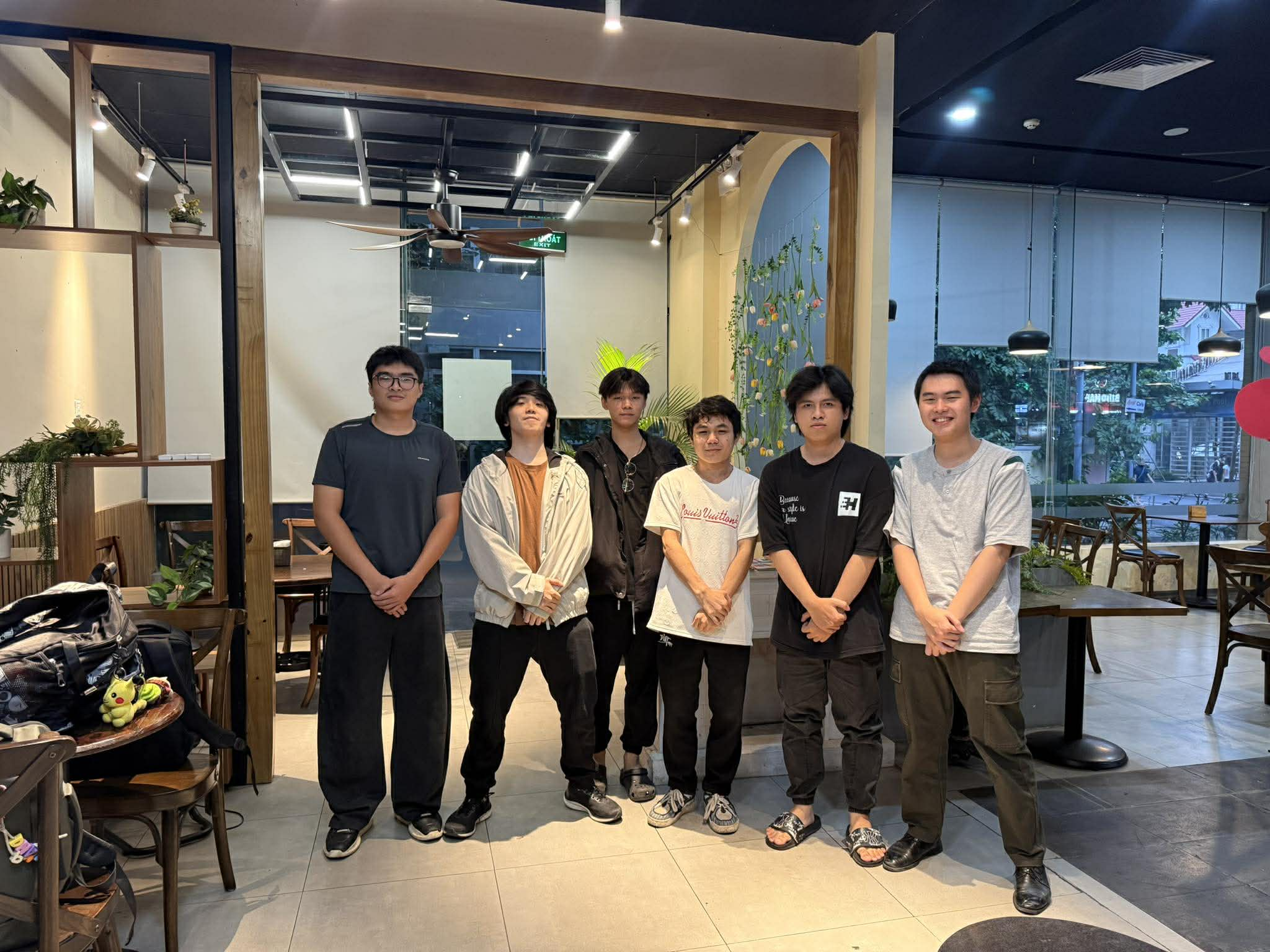
Alright, now comes the location.
This is where the current ‘office’ of RHINELAB are situated within, and I would say we are doing quite well with how the operations are going. To be in truth, I feel like we are progressing for material accumulation pretty much alright.
Important
Recently, basing on a new organization template, the laboratory decided to change from Group to Division for its uppermost bracketing. This means that everyone will be in departments as nominal for now, resultant consequences later, even then though, we will have hierarchy down below it.
His vision and purpose embedded to RHINELAB (or more so of its second name as RINALAB), is to be an open-source, open-discourse, open-knowledge with caveat, research and foundational knowledge laboratory, laying on the principle of principle logistics and question-generative research - where the main goal of research is to ask more questions, correctly so. Explicitly stated, the organization, owned by him as it is, focus on its intellectual contents and resources to be \((i)\) contextually open-source, accessible for all aside from private and sensitive operational and managerial information, \((ii)\) every question, every intellectual discourse or argument debate are to be, in conjunction with rules of expression, accepted of discussions and existence; this is extended to open-knowledge, that is, ideally that the lab would try to do and experiment on this mode is to expose all intellectual results to the public space governed by the lab system, auditing research movements within rules and attribution of the people created those resources, and so on. Furthermore, \((iii)\), he aims for the creation and crystallization of foundational investigation and research, as the core research arrow of the laboratory to investigate deep, recreating and capture foundations and further spin-out knowledge rather than just consumption or relying on source availability 2 - it also means one of the main goal of the lab is to build on itself, a basis of knowledge and library of Alexandria for RHINELAB in its entirety. Finally, \((iv)\), he emphasizes the need for researching and deploying logistical support and smoothing for researcher, the researching machines and constructs. He believes that without principle logistics, something like Occam’s razor, then research would be tiresome, hard, difficult with high barrier of entries, and tedious beyond measure of what is required.
Modelling, Theoretical Artificial Intelligence and Learning-theoretic Division (RHINE-MTAIL)
One of the central group of the laboratory itself. In basic formation, it is the one that gave rise to all succeeding groups below on methodology and modelling theory choices, knowledge and principles. The group are current studying on:
- Theoretical learning theory, specifically on statistical learning theory and the double descent dilemma theoretical analysis.
- Modelling theory and the formal modelling theory. This includes Ambiance-Encoding Theory (AET), mathematical operationalisation theory (M-oper), and minimal representation theory on modelling substrates.
- Theoretical computer science and the expansion of such to a more generalized theory itself. For example, non-binary information theory on \(n\)-signal, and abstraction levels of theoretical-practical gap between computer and its theoretical implementation - which includes the application of Rice’s theorem (for a real quick reference, just look into this or this paper, which might seem to be a deviation thereof) to the analysis itself.
Artificial Intelligence Research Division (RHINE-TAAI)
While distinctive from the purpose of the above group (while still having the name), the artificial intelligence group focuses on the theoretical research and implementation system of the subject matter, as well as to analyze and reformalize what to be of the field of artificial intelligence, as well as its precursor disciplines, such as system theory, control theory, cybernetics, classical artificial intelligence substrates and the philosophy of such. Currently, the laboratory is aiming toward,
- Characterization of artificial intelligence and new organization of formalized theory of artificial intelligence, modelling, learning theory (machine learning systems), and dynamical theory, alongside theoretical audits and conceptual explorations.
- Implementation and utilization of systems of interest, of practical AI system or proto-AI, and/or different paradigms and architectures of constructions. This includes two main projects: implementation of a new neural network architectural in organization, and physically-realized neural architecture (hardware-based). Third project in proposal idea stage include an attempt (experimental) with structural audits on building an AI system from scratch that encompasses the scope similar to agentic AI, but structurally different.
Such will include multi-stage, long-term planning. Currently, we are in phase zero, and will soon move on to phase 1 of investigation. The main idea, again, is that we want to examine practical in-depth systems of which the practical system can reach without throwing only neural network on tops (the odd works done already), while simultaneously trying to interpret and structurally construct components of the notion of artificial intelligence, such is to say we do not recognize NLP or CV as AI but components thereof.
Mathematical and Physical Research Division (RHINE-MAPR)
The Mathematical and Physical Research group consists of two sections, obviously, of the Mathematical Research Group or directive, and Theoretical Physics Research Group accordingly. The main goal as of now for both teams are in auditing, foundation building and research on mathematical and physical framework, specifically:
- Characterization of mathematical foundations and buildup, analyzing mathematics under modelling, abstraction and language perspective.
- Foundational knowledge building with initial phase of current being materials on internal reports, bookkeeping, reading sessions and analytic notes, surveys, proposals, question and debate notes, research finding and reports, inquiry and so on.
- Characterization of physical foundation, history and epistemology, mathematical utilization and the usage of physics with logical apprehension on top. Basically, we trace through everything, even failed models as vortex models and extract what are there and what can be done. This also helps in determining current mistake in modelling and thereof, for example many assumption-laid dilemma in modern models.
Under such umbrella of methodology, current groups are separated into several named groups. Briefly speaking, we have:
Mathematical physics group
Investigating foundation of mathematical physics, logical history and modelling theory of mathematical physics, and construction of new mathematical physics framework on specified choice of model-perspective. ODE and PDE epistemology.
Signal processing and harmonic analysis group
Analyzing harmonic distortion and music-oriented theoretical control, signal processing and hardware corruption principles.
RHINELAB Nuclear Physics Research Division (RHINE-NCPR)
This group is more practical, as it focus on foundational knowledge of nuclear science but also nuclear devices, theoretical nuclear sciences and nuclear mechanical functional analysis. This includes simulation and mostly theoretical, until further specified on any collaborative request.
Encyclopaedia, Foundational and Pedagogical Research Division (RHINE-EPEFORM)
This group is rather thinly introduced, but however it is settled to put up forth a general foundational stack on knowledge, specialized knowledge, domain knowledge, analysis, interpretation, debate, opinions, questions, identification of paradox or structural incompleteness, and so on of fields of interesting. At current, foundational topics in demands of the highest order are:
- Computer science and theoretical computer science; network theory and automata/cellular automata theory.
- Physics; classical and quantum mechanics, near-relativistic physics and material sciences.
- Biology and foundational biology; computational biology and computational/theoretical neuroscience.
- Foundational analysis.
- Foundation of philosophy and analytical philosophy.
- Mathematics; continuous-based mathematics (analysis, differential topology, algebraic topology, homotopy theory, point-set topology), combinatorial species, category theory and weak-category theories, logic and higher logic theory, formal set theory Von-Neumann set-class model, stochastic process and evolution theory.
- Chemistry and quantum chemistry; current subcategory are undetermined.
- Geophysics; meteorology and climatology.
The list is incomplete. Further increment are guaranteed, so it would be expected to grow in the near future after phase I.
Footnotes
In short, this means for the object or any given writing, specification “on paper” to be fully realized, perhaps physically or concretely speaking, that can be manipulated, identified, with actions available, for forms consistent and limited.↩︎
This simply means that we do not just accept there is a review by someone, a textbook or any sources then move on, but to recrystallize our understanding of sort, and creating our own knowledge encyclopaedia.↩︎